Monday, November 15, 2010

Social Media Era has Changed the way Businesses Interact With Customers

We all wonder about this social media and where it is going. It's not just for college kids anymore as it originally was designed for seven years ago. Its most popular use in the past by the younger generation was to keep in touch and to see what their friends and family were up to. Social media has evolved past its adolescence stage and fully blossomed to its full potential in the Internet world. Social media is forging a new era within the businesses world.

More and more businesses are starting to utilize these social medias such as Facebook, Twitter, YouTube, and Blogs to reach out to their customers. The problem most businesses have with creating these outlets is that they fail to see the monetary value in using them. They want to visually see the return on investment (ROI). As our professor says, "money talks." This holds true for all business.

However, with the age of social media, the rules have changed dramatically and businesses are starting to realize that the true monetary value comes out of reaching out to their customers and making them apart of the business personally. Social media is creating engagement and transparency within the business and creating both new challenges and opportunities. Businesses no longer have to rely on press releases and campaigns to communicate with their customers and this is a promising future for the business world.

In this video from YouTube.com, it describes social media as a force, a revolution. It is just this.


Social media is allowing companies to make a choice. To be controlled and hidden, or reveal their human side and show their customers they care directly via social media.

In a current article I came across recently talks about Four ways Social Media is Changing Busniesses,” it was published on Mashable.com. It discusses four ways that social media and businesses are flourishing together and changing the way the business world is communicating to its customers.

1. From “Trying to Sell” to “Making Connections”

For a company to change this relationship from "trying to Sell" to seeking engagement, they need to utilize Facebook and Twitter, to socially interact. They should post less about the products and services and more about the things that help their customers get to know the people and personality of the company. As a result, people will be more willing to accept the company as a comfort zone.

2. From “Large Campaigns” to “Small Acts”

By utilizing sites like Facebook and Twitter, the company basically has it’s own broadcasting network where they control the content they put out. Businesses are realizing that this is a way to save millions of dollars in advertising and campaign ads. This form of “small acts” is valuable because people inadvertently will share their experiences through the social web. In a matter of minutes, the company can tell their customers all their good and bad news and small issues from customers can quickly become important, which makes them feel connected to the company.

3. From “Controlling Our Image” to “Being Ourselves”

The goal should not be to create a polished and controlled image but to let everyone see that they are a company made up of human beings and not robots. One way is to let the employees be able to write about the company but intact policies to help regulate the type of content put out. This is a way to have a more active and engaged customer. It lets the average person see what is really going on and to not just corporate jargon.

4. From “Hard to Reach” to “Available Everywhere”

Finally, social media allows the company to re-define what it means to engage the customer. It is no longer acceptable to have an e-mail address and customer service number on one’s website. People want to interact with businesses directly and with the staggering amount of people turning to social media to look up companies it would be a death sentence to not have a social media presence.

Social media is changing the way we think about businesses. It is changing the way we interact with people in general. Businesses are seeing this as an opportunity and jumping on board and running with the crowd. For the businesses not going with this… they need to get on the ball. There are ways to evaluate the ROI, but the most important part of this new era of social media is to ENGAGE and make the customer apart of the business.

- Tiffany Langello

Sunday, November 14, 2010

Troubling Tweets

If someone asked you what the policies of social media entailed, would you be able to provide him or her with a clear answer? I know I wouldn’t be able to. Social media is quickly evolving and with that evolution, the rules surrounding social media outlets continue to change as well.

One social media outlet that certainly doesn’t have many “black and white” guidelines is Twitter. When I think of Twitter, celebrities instantly pop into my head. Anyone can follow celebrities and stay up to date with what they are tweeting. But are there rules as to what they can tweet? How about guidelines for what I can tweet about? Can Twitter be utilized as a platform where you can tweet about anything and no consequences will follow? How can you differentiate between tweeting a joke, and tweeting a threat?

I can go on with question after question. You too may be thinking what is appropriate to tweet. The reality of it is, the world is continuously trying to figure it out.

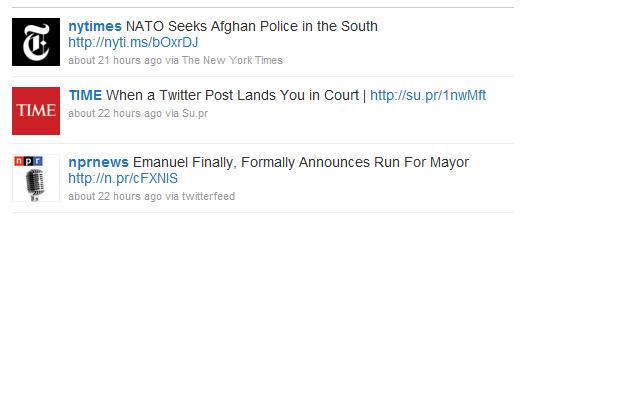
A current article that I stumbled upon my Twitter homepage titled “When a Twitter Post Can Land You in Court,” was published on time.com. It discussed a case where a tweet was viewed more than just a joke.

Gareth Compton, a British politician tweeted after Yasmin Alibhai-Brown, a journalist for London’s Independent newspaper made a statement on radio in regards to the moral qualifications of British politicians to comment on human-rights issues such as the stoning of women. Compton’s tweet read, "Can someone please stone Yasmin Alibhai-Brown to death? I shan't tell Amnesty if you don't. It would be a blessing, really."

The police in London viewed this tweet as a violation of the Communications Act of 2003. According to the article, Compton was released on bail, as further investigation continues.

Although I still cannot develop a clear answer to the question of what the policies of social media entail, I can tell you that it’s important to think twice before you tweet something that you may view as harmless. You just don’t know how others will interpret it. That’s simply it…interpretation. It’s important to avoid any future trouble with your tweets by making sure your intent will certainly match interpretation.
-Angela Daidone

Tuesday, November 9, 2010

Social Media Sobriety Test

It's Friday afternoon and you've had a long and stressful week at school.  You decide to hit up happy hour which leads to more drinks at your favorite bar which then leads to an eventful night out with your best friends.  After multiple beers, a Jack and Coke and possibly a few shots, you decide it's about that time to head back to your house.

Before going to bed, it's only natural to hop on the Internet and log into your favorite social media accounts.  With the alcohol talking and taking control of the keyboard you decide to write on your ex-boyfriend or girlfriends wall about how you hate them, tweet about how much you disagree with your boss whom happens to be one of your followers or leave a disturbing Facebook status that will have your mother (who yes, is your Facebook friend) frantically calling you in the morning.

Well folks, you are now in luck because Software company Webroot has come out with a FireFox plug-in that doesn't let you post on your social media pages late at night without passing a sobriety test first.  The Social Media Sobriety Test allows you to specify a period of time when you believe you will be on the Internet while under the influence (possibly 2AM to 4AM) and anytime you try to access the Internet during that time frame, you'll have to prove your sobriety.

This sobriety test locks down your social networks including Facebook, Twitter, Flickr, YouTube, Tumblr and MySpace.  (However, if you still have a MySpace account, drinking is the least of your worries.)  If these sites are visited during your intoxicated time frame you will be asked to pass tests similar to ones policemen would ask if you were pulled over on the side of the road like seeing if you can make your cursor follow a moving finger for 30 seconds.


The funny part: if you fail, the program automatically posts a status for you that says, "[Your name here] is too intoxicated to post right now."  I mean, how embarrassing right?  The Social Media Sobriety Test is free and works wherever Google Chrome and FireFox do.

Install The Social Media Sobriety Test today!


- Lauren Vocelle